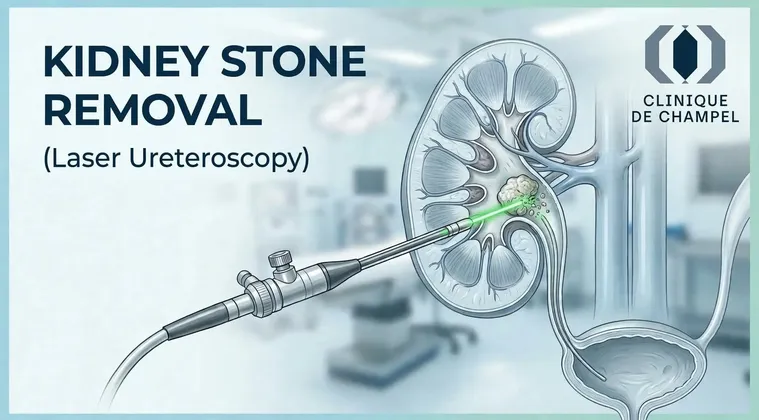
Laser ureteroscopy is a reference technique for treating stones in the ureter and kidney. Performed entirely through natural passages, without any incision, it involves guiding a thin camera (flexible or rigid ureteroscope) up to the stone, then fragmenting or vaporizing it using a laser.
The fragments are then naturally expelled in the urine or removed with a small basket. This minimally invasive approach allows for outpatient management in most cases.
At the Centre Chirurgical de Champel, in Geneva, urinary stone treatment is performed by experienced urologists, using state-of-the-art flexible endoscopy equipment and a latest-generation laser, on an outpatient basis.
When should a stone be treated with laser ureteroscopy?
- Ureteral stone causing pain (renal colic) or blockage
- Small to medium-sized kidney stone
- Failure or contraindication of shock wave treatment (extracorporeal lithotripsy)
- Stone resistant to spontaneous elimination
Treatment is indicated when the stone causes symptoms or cannot be eliminated naturally.
Before the procedure
Preliminary assessment:
- 01 Imaging (CT scan) to locate and measure the stone
- 02 Sterile urine analysis (ECBU), essential before the procedure
- 03 Anesthesia consultation and consent form
A urinary tract infection must be treated before the procedure.
Procedure steps
Duration: approximately 30 to 60 minutes depending on stone size and location. Anesthesia: general most often. The choice is made with the anesthesiologist.
Main steps:
- 01 Insertion of the ureteroscope through natural passages up to the stone
- 02 Locating the stone under video control (and radiological control if needed)
- 03 Fragmentation or vaporization of the stone with laser
- 04 Extraction of fragments and/or natural expulsion
- 05 Frequent placement of a double J stent to facilitate elimination and protect the ureter
The procedure is performed without external incision, on an outpatient basis in most cases.
After the procedure
Usual follow-up
- Temporary double J stent often placed, removed later
- Burning sensation during urination, frequent urges, and traces of blood in the urine
- Possible moderate lower back pain while fragments are being eliminated
Recommendations
- Drink plenty of fluids to aid fragment elimination
- Optionally filter urine to collect fragments for analysis
- Consult a doctor in case of fever, severe pain, or significant bleeding
Expected outcome: the stone is eliminated, and its composition analyzed to prevent recurrence.
Follow-up
A follow-up appointment checks for complete stone elimination and schedules the removal of the double J stent. Recurrence prevention measures are offered: stone analysis, metabolic assessment, and dietary advice.
Renal colic or a stone to treat?
Our urologists will see you for a consultation in Geneva, analyze your imaging, and propose the most suitable technique for your stone.