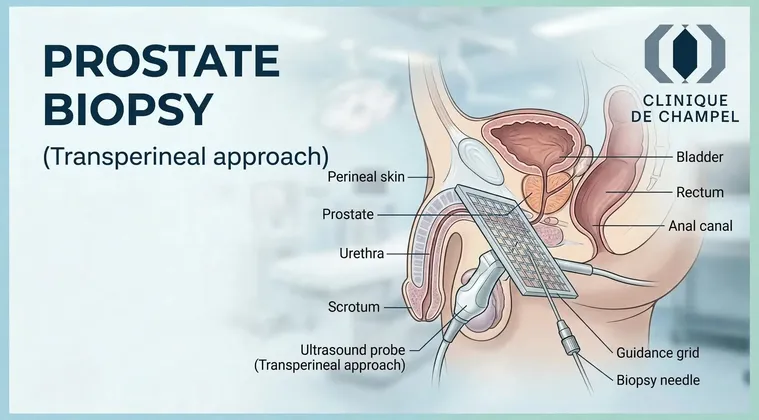
Prostate biopsy involves taking small tissue samples from the prostate gland for microscopic analysis, with the aim of detecting or ruling out cancer.
It is performed via the transperineal route (through the skin between the scrotum and the anus), which is now considered the standard approach as it significantly reduces the risk of infection compared to the transrectal route.
At the Centre Chirurgical de Champel, in Geneva, prostate biopsies are performed via the transperineal route by experienced urologists, using state-of-the-art imaging guidance, on an outpatient basis.
When is a prostate biopsy needed?
- Elevated or rising PSA level
- Abnormality detected during rectal examination
- Suspicious area identified on prostate MRI
- Monitoring of a known abnormality
A biopsy is indicated when there is persistent doubt about the presence of prostate cancer.
Before the procedure
Preliminary assessment:
- 01 Prostate MRI to target areas for sampling
- 02 Urine analysis (ECBU) and review of anticoagulant therapy
- 03 Patient information and consent form
Antibiotic prophylaxis protocols are adapted for the transperineal approach.
Procedure details
Duration: approximately 15 to 30 minutes. Anesthesia: local, by infiltration of the perineum and around the prostate. The examination is generally very well tolerated. Sedation or general anesthesia can be offered to very anxious patients.
Main steps:
- 01 Administration of local anesthesia
- 02 Ultrasound guidance, often combined with MRI images (fusion) to target suspicious areas
- 03 Collection of several tissue samples through the perineal skin
- 04 Application of a simple dressing
The procedure is performed on an outpatient basis, without passing through the rectum.
After the procedure
Usual follow-up
- Blood in urine and semen for a few days to a few weeks
- Moderate perineal discomfort
- Rapid return to activities
Recommendations
- Drink plenty of fluids
- Avoid strenuous activity for 24 to 48 hours
- Consult if you experience fever, difficulty urinating, or significant bleeding
Expected outcome: analysis of the samples allows for a precise diagnosis and, if necessary, guides further management.
Follow-up
Results are explained during a consultation, along with the recommended course of action for each situation.
Elevated PSA or suspicious MRI?
Our urologists will review your results during a consultation in Geneva and explain if a transperineal biopsy is indicated.