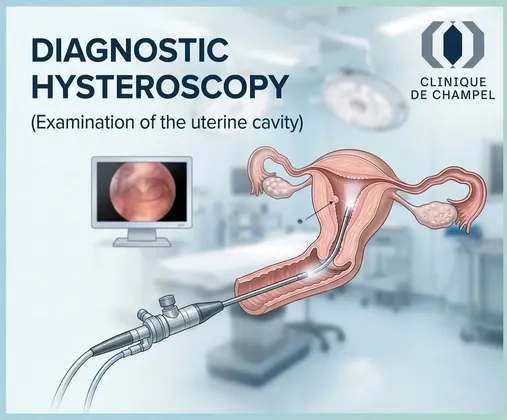
Diagnostic hysteroscopy is an examination that allows visualization of the inside of the uterus using a very fine camera, the hysteroscope, inserted through the natural passages.
Thanks to miniaturized equipment and the vaginoscopy technique (without a speculum), this examination is now minimally invasive, quick, and most often painless.
At the Centre Chirurgical de Champel in Geneva, diagnostic hysteroscopy is performed by experienced gynecologists using state-of-the-art miniaturized endoscopy equipment in a comfortable setting.
When to perform a diagnostic hysteroscopy?
- Abnormal bleeding (heavy periods, bleeding between periods, or after menopause)
- Thickening of the uterine lining detected by ultrasound
- Work-up for infertility or recurrent miscarriages
- Suspicion of a polyp, fibroid, or uterine malformation
- Locating and removing an inaccessible IUD
The examination is indicated whenever direct exploration of the uterine cavity is necessary.
Before the examination
Preliminary assessment:
- 01 Ideally schedule the exam in the first half of the cycle, between periods
- 02 Rule out pregnancy or current infection
- 03 Patient information
Procedure of the examination
Duration: approximately 5 to 15 minutes. Anesthesia: most often none; local anesthesia may be used. Light sedation can be offered to anxious patients.
Main steps:
- 01 Positioning in the gynecological position
- 02 Gentle insertion of the hysteroscope vaginally, without a speculum (vaginoscopy)
- 03 Distension of the uterine cavity with physiological serum
- 04 Complete inspection of the cavity and tubal ostia
- 05 Tissue sample (biopsy) if an abnormality is found
The examination is performed without incision and allows for a rapid return to activities.
After the examination
Usual after-effects
- Mild period-like cramps for 1 to 2 days
- Light bleeding for 1 to 2 days
- Resumption of activities immediately after
Recommendations
- Avoid baths and intercourse for a few days if a biopsy was taken
- Consult if fever, pain, or heavy bleeding occurs
Expected outcome: direct visualization of the uterine cavity allows for immediate diagnosis and guidance for management.
Follow-up
Results are explained during the consultation. Operative hysteroscopy may be proposed if necessary.
Abnormal bleeding to investigate?
Our gynecologists will see you for a consultation in Geneva and determine if diagnostic hysteroscopy is indicated.