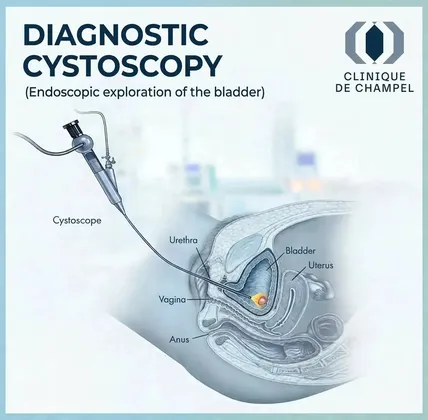
Diagnostic cystoscopy is an endoscopic examination that allows exploration of the inside of the bladder and urethra using a miniaturized camera, the cystoscope, inserted through the natural passages. It provides direct visualization of the bladder wall and helps identify the cause of urinary symptoms.
It is most often performed in cases of blood in the urine, recurrent urinary infections, or persistent urinary problems, and is a reference examination for monitoring certain bladder conditions.
At the Champel Surgical Center in Geneva, diagnostic cystoscopy is performed with the latest generation of endoscopy equipment, by experienced urologists, in a safe and comfortable outpatient setting.
When to have a diagnostic cystoscopy?
- Presence of blood in the urine (hematuria), visible or detected by analysis
- Recurrent or unexplained urinary infections
- Persistent urinary problems (burning, frequent urges, difficulty urinating)
- Monitoring of a known bladder tumor or lesion
- Suspicion of urethral stricture, stone, or foreign body
The examination is indicated whenever direct exploration of the bladder is necessary to make or confirm a diagnosis.
Before the examination
Preliminary assessment:
- 01 Urine analysis (midstream culture) to rule out active urinary infection
- 02 Review of current medications, especially anticoagulants
- 03 Patient information and consent
An active urinary infection must be treated before the examination. Antibiotic prophylaxis may be prescribed depending on the situation.
Procedure of the examination
Duration: approximately 5 to 15 minutes. Anesthesia: local, by instillation of an anesthetic and lubricating gel into the urethra. Light sedation may be offered to anxious patients.
Main steps:
- 01 Application of anesthetic gel in the urethra
- 02 Gentle insertion of the cystoscope (flexible or rigid) through the urinary tract
- 03 Complete inspection of the urethra, bladder neck, and bladder wall
- 04 Possible biopsy if an abnormality is found
The examination is performed on an outpatient basis and requires no incision.
After the examination
Usual post-procedure course
- Slight burning during urination and frequent urge to urinate for 24 to 48 hours
- Possible traces of blood in the urine in the first few days
- Immediate resumption of usual activities
Recommendations
- Drink plenty of fluids to aid elimination
- Monitor temperature
- Consult if you have a fever, significant pain, or inability to urinate
Expected result: the images obtained allow the surgeon to establish an immediate diagnosis and, if necessary, to plan further management.
Follow-up
The results are explained at the end of the examination or during a dedicated consultation. A follow-up cystoscopy may be scheduled as part of monitoring for certain conditions.
A question about diagnostic cystoscopy?
Our urologists will see you for a consultation in Geneva to assess your symptoms and determine if this examination is appropriate for you.